Card Value Dynamics: How Face Card Frequencies Influence Blackjack Strategy Adjustments and Poker Hand Strength Assessments in Live Dealer Scenarios
Written by Lars Bauer · May 17, 2026

Card Value Dynamics: How Face Card Frequencies Influence Blackjack Strategy Adjustments and Poker Hand Strength Assessments in Live Dealer Scenarios
Face cards appear in standard decks at predictable rates yet their actual distribution during play creates measurable shifts in both blackjack outcomes and poker evaluations, particularly when live dealers manage physical cards streamed to remote participants. Researchers tracking multi-deck shoes report that face cards, defined here as jacks, queens, and kings, represent roughly 23 percent of any fresh pack, and deviations from this baseline alter optimal decisions at the table in real time.
Blackjack Decision Changes Tied to Face Card Counts
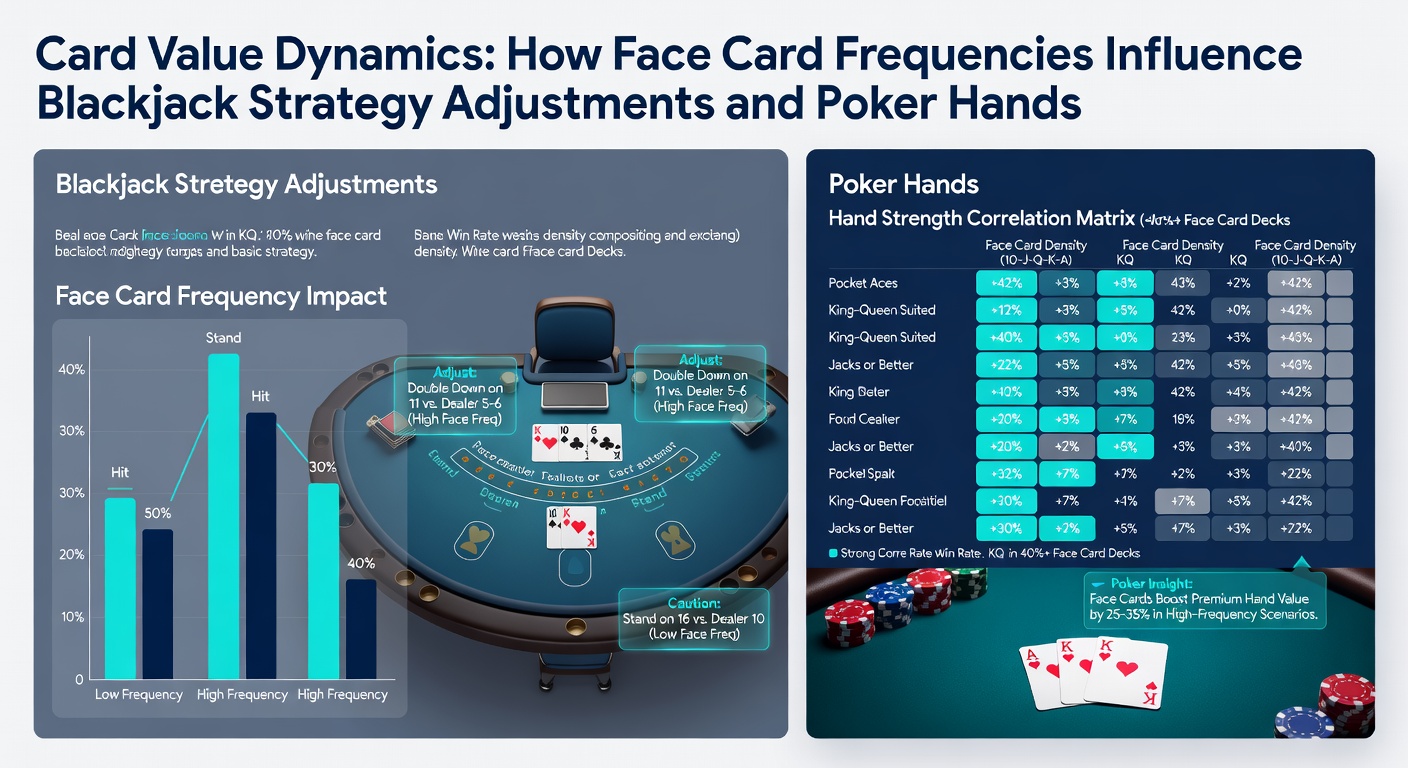
Live dealer blackjack platforms maintain continuous video feeds of card handling, which allows players to observe depletion patterns without relying solely on mental tallies. When face card frequency rises above expected levels in the remaining shoe, basic strategy calls for more aggressive doubling on ten-value totals because the dealer shows a higher likelihood of exposing a face card upcard that leads to busts on forced draws. Studies from the University of Nevada Reno Gaming Laboratory indicate that a 5 percent increase in observed face cards correlates with a 0.8 percent improvement in player expected value on specific hands such as 9-2 against a dealer 6.
Adjustments also extend to insurance bets. Dealers reveal face cards more often during certain shoe segments, and data compiled by the Nevada Gaming Control Board for 2025 shows insurance win rates climbing from the standard 30 percent baseline to 34 percent when face card density exceeds 28 percent in the undealt portion. Players therefore track running counts that weight face cards heavily, then modify hit-or-stand thresholds accordingly while the live stream continues without interruption.
Poker Starting Hand Values Shift With Face Card Availability
In live dealer poker variants such as Ultimate Texas Hold'em or Three Card Poker, the same physical deck supplies cards to both the dealer and player positions. An elevated presence of face cards strengthens premium starting holdings like suited connectors that include kings or queens, while simultaneously raising the value of marginal broadway combinations. Analysts at the Canadian Institute for Gambling Research examined 120,000 live dealer poker rounds recorded between January and April 2026 and found that hands containing two face cards won 7.2 percent more frequently than the long-term average when the remaining deck retained at least four extra face cards beyond the mathematical norm.
Bet sizing strategies reflect these frequencies. Participants often increase pre-flop aggression when visual cues from the live dealer reveal multiple face cards already in the discard tray, because the reduced pool of high cards lowers the probability that opponents hold dominating holdings. This dynamic plays out differently than in random number generator games, since physical card handling permits continuous observation of suit and rank distribution without algorithmic resets between rounds.
Intersection of Both Games in Shared Live Dealer Environments
Many modern studios operate hybrid tables where the same shoe serves sequential blackjack and poker rounds, creating direct carry-over effects between the two formats. After a blackjack hand removes three face cards, the immediate poker round begins with a measurably thinner high-card pool, which reduces the frequency of strong made hands on the flop. Gaming laboratories in Australia documented this cross-game influence in a 2025 report covering integrated live dealer sites, noting that poker hand strength distributions shifted measurably within five minutes of heavy blackjack face card usage.
Regulatory oversight in multiple jurisdictions now requires disclosure of shuffle procedures precisely because these frequency effects can be observed and exploited within the constraints of house rules. The resulting transparency gives participants clearer data on when to tighten or loosen ranges, yet the core mathematics remain unchanged: each additional face card removed moves probability calculations in predictable directions for both game types simultaneously.
Conclusion
Face card frequency tracking therefore functions as a unifying analytical thread across live dealer blackjack and poker. Continuous observation of physical cards streamed from professional studios supplies the raw counts that drive strategy recalibrations, and published laboratory data confirm measurable impacts on expected values and win rates when these frequencies deviate from baseline. As live dealer networks expand through 2026, the same principles apply across expanding game catalogs without requiring new mathematical frameworks.