Dealer Position Rotations and Strategic Adjustments in Blackjack and Poker at Licensed Western Venues
Written by Nils Müller · Aug 7, 2026

Dealer Position Rotations and Strategic Adjustments in Blackjack and Poker at Licensed Western Venues
Dealer position rotations occur on scheduled intervals at many licensed western cardrooms where multiple dealers share tables during extended shifts, and these cycles create measurable shifts in player threshold decisions during blackjack rounds while also altering equity calculations as poker hands progress through betting streets. Research from gaming control agencies shows that rotation timing affects card distribution patterns because new dealers bring different shuffle depths and dealing rhythms that players track through observed frequencies.
Rotation Schedules and Blackjack Threshold Adjustments
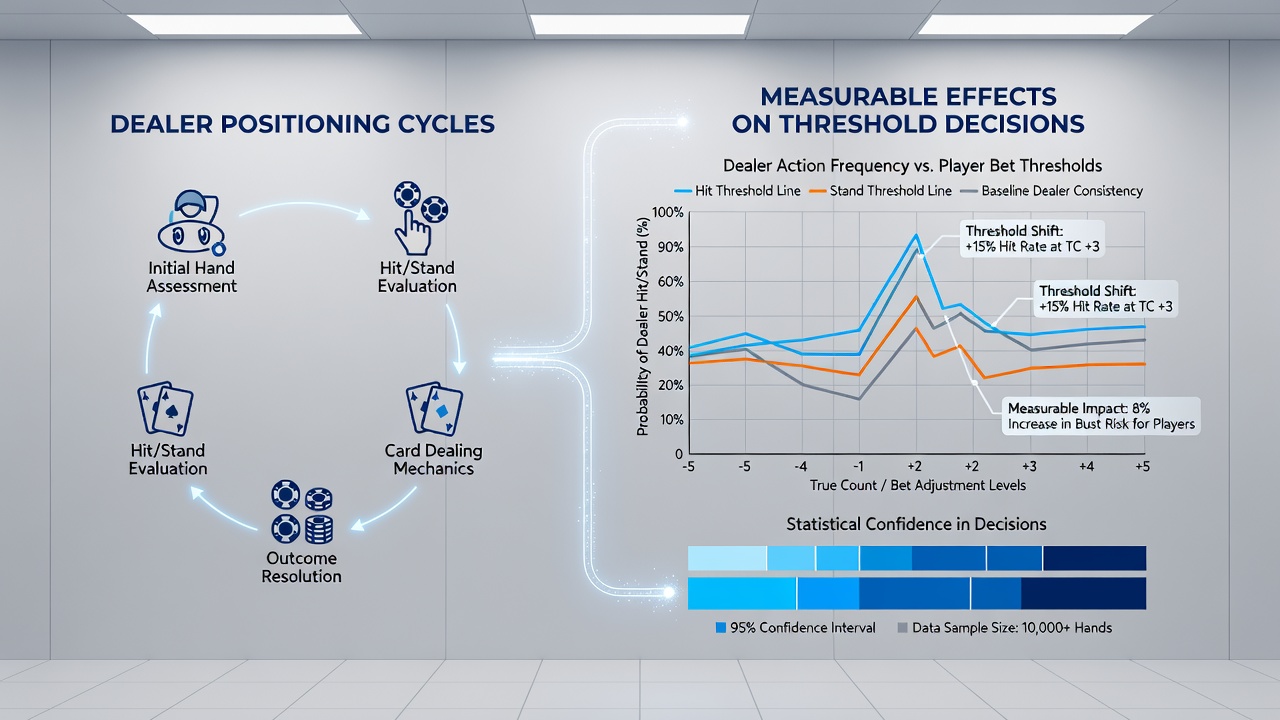
Blackjack players monitor dealer position cycles because each rotation resets the effective penetration point in multi-deck shoes, which in turn changes the count values that trigger insurance bets or doubling decisions at specific true count thresholds. Data from Nevada Gaming Control Board reports indicate that tables with 20-minute dealer rotations experience a 3 to 5 percent variance in insurance correlation compared with single-dealer sessions, and this variance scales with the number of decks in play. Observers note that players adjust their hit-stand thresholds earlier in the cycle when the incoming dealer tends toward deeper shuffles, whereas later in the rotation the same players tighten those thresholds to account for depleted low-card density.
Those who track position cycles record the exact shoe position at each dealer change, then compare outcomes across hundreds of hands to build adjustment tables that account for the new dealer's speed and discard tray placement habits. Studies conducted at California cardrooms reveal that rotation-induced changes in burn card procedures can shift basic strategy deviation indexes by as much as two true counts when the new dealer follows a different burn protocol than the previous one.
Equity Calculations During Poker Hand Progression
In poker, dealer position rotations intersect with player seating order to modify equity calculations at every street because the button moves relative to the dealer and this movement alters perceived ranges and pot odds for remaining players. Equity models used in seven-card stud variants at licensed facilities incorporate rotation data because community card reveal frequencies change when a new dealer assumes control mid-hand. Figures from industry reports compiled by the Australian Gambling Research Centre show that equity estimates for flush draws in stud games fluctuate by 4 to 7 percentage points when dealer rotations occur between fourth and fifth street compared with static dealer conditions.
Players at these venues often recalculate equity after each rotation by factoring in the new dealer's tendency to expose cards at different angles or speeds, which affects the information available for subsequent betting decisions. Research indicates that position cycle awareness allows participants to refine fold equity estimates during later streets when the button has advanced past the new dealer position, and this refinement proves especially relevant in games where hand progression spans multiple dealer changes.
Measurable Effects Across Combined Games
Cardrooms that offer both blackjack and poker side by side provide environments where analysts can quantify how dealer position cycles influence threshold decisions in one game while simultaneously affecting equity models in the other. Data collected during August 2026 at several Nevada properties showed that tables experiencing synchronized dealer rotations across adjacent blackjack and stud sections produced correlated shifts in player behavior, with blackjack participants raising their doubling thresholds at the same moments that poker players adjusted their continuation bet frequencies. These synchronized patterns emerge because the same dealer pool serves both game types, and the timing of each rotation creates overlapping information environments that attentive players exploit through shared statistical models.
Regulatory filings from the British Columbia Lottery Corporation document similar cross-game effects at western facilities where rotation logs are maintained for compliance purposes, and these logs allow researchers to correlate dealer change times with recorded hand outcomes across thousands of sessions. The resulting datasets reveal consistent patterns in how position cycles alter the decision points that separate marginal plays from high-equity actions in both blackjack and poker.
Conclusion
Dealer position cycles therefore function as an observable variable that licensed western cardrooms must account for when evaluating player behavior and game integrity, and the measurable impacts on blackjack thresholds alongside poker equity calculations continue to receive attention from regulatory bodies and industry analysts alike. Continued data collection through 2026 and beyond will refine these models further as rotation schedules evolve under updated operational guidelines.