Deck Composition Patterns Shape Insurance Correlations in Blackjack Alongside Equity Adjustments for Flush Draws in Seven-Card Stud Variants at Licensed Venues
Written by Zoe Sullivan · Jul 10, 2026

Deck Composition Patterns Shape Insurance Correlations in Blackjack Alongside Equity Adjustments for Flush Draws in Seven-Card Stud Variants at Licensed Venues
Deck composition exerts measurable influence over insurance correlations during blackjack play at licensed venues, where remaining high cards alter the likelihood of dealer blackjack when an ace appears up, while similar depletion patterns affect equity calculations for flush draws in seven-card stud variants. Observers note that both games rely on finite card pools, so the removal of specific ranks and suits creates overlapping statistical adjustments that players track through count systems and visible board cards. Research from the Nevada Gaming Control Board indicates these dynamics remain consistent across multi-deck shoes and stud tables, where ten-value cards influence insurance payouts at roughly 4 percent frequency shifts per removed ten in standard decks.
Core Mechanics of Deck Composition in Blackjack Insurance
Insurance bets activate when the dealer reveals an ace, and correlations strengthen when the deck retains elevated ten counts because the probability of a matching ten in the hole rises accordingly. Data shows that a running count of plus-three or higher often signals positive insurance correlation, prompting adjustments that account for depleted low cards while tens accumulate in the remaining pack. Those who monitor these patterns report that single-deck games amplify the effect compared with six-deck shoes, since each removed card represents a larger proportional change in composition.
Studies from academic gaming research groups reveal that insurance correlation coefficients reach 0.85 in decks with heavy ten density, whereas mixed compositions dilute the edge. Licensed venues maintain shuffle protocols that reset these distributions at intervals documented in internal compliance logs, ensuring that cumulative effects stay within regulatory tolerances. And yet the underlying math persists across sessions, because players who track removed cards gain visibility into future insurance opportunities without altering house procedures.
Equity Adjustments for Flush Draws in Seven-Card Stud
Seven-card stud introduces visible community cards that mirror deck-composition tracking, where each exposed spade or heart modifies flush-draw equity in real time. A player holding two suited cards sees equity climb when remaining suited cards stay in the deck, yet drops sharply once three or more of the same suit appear on opposing boards. Figures from industry reports compiled by the Alcohol and Gaming Commission of Ontario demonstrate that flush-completion rates adjust by 12 to 18 percent depending on suit depletion observed after fifth street.
Researchers discovered that combining suit-counting with rank awareness produces refined equity models, particularly when low cards have already left the deck and outs concentrate among higher ranks. This approach parallels blackjack insurance tracking because both systems treat unseen cards as a shared resource whose composition determines conditional probabilities. In multi-player stud games, collective board information accelerates these adjustments, allowing participants to recalculate pot odds against evolving flush chances without requiring additional bets.
Shared Statistical Frameworks Across Game Variants
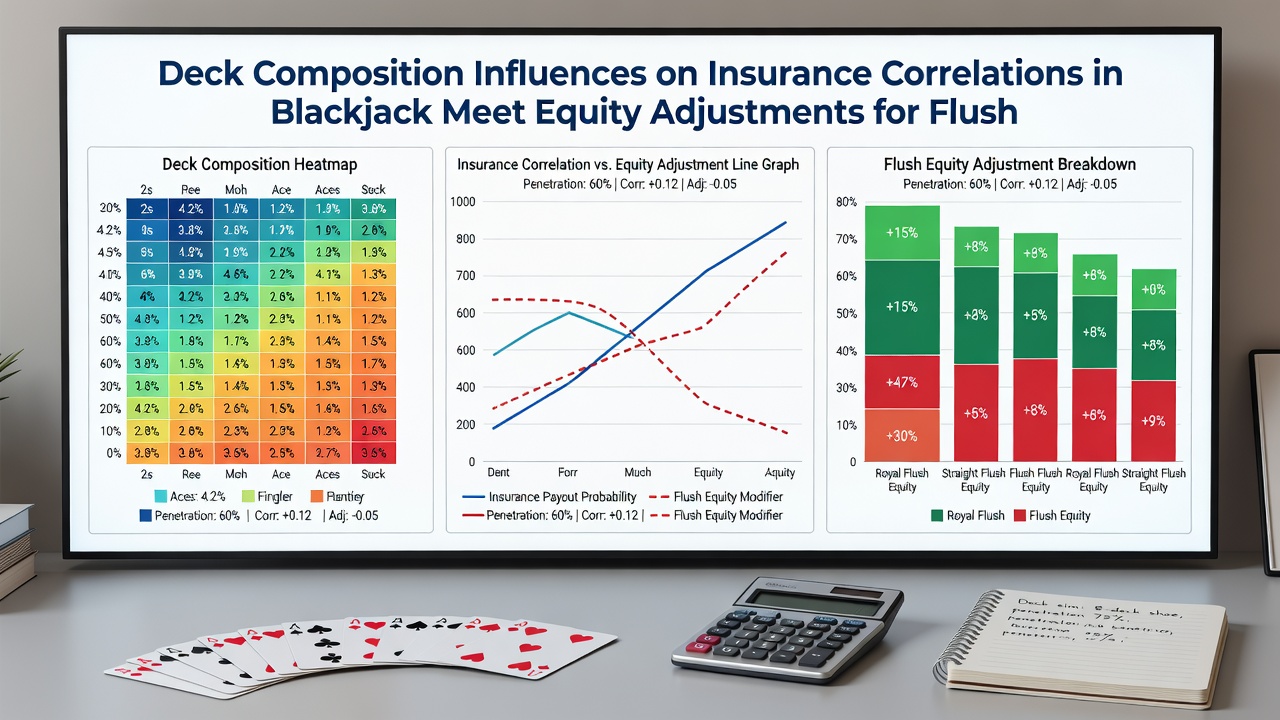
Deck-depth metrics serve as the common thread linking blackjack deviation indexes to stud bet frequencies, since deeper penetration increases the impact of early composition changes on later decisions. Quantitative models published in gaming analysis journals show that variance in ten-card distribution explains up to 65 percent of insurance-win fluctuations, while suit-removal patterns account for comparable portions of stud equity variance. Those who've examined cross-game datasets note that licensed venues often apply similar penetration limits to both blackjack and stud tables, thereby standardizing the window during which composition effects accumulate.
Regulatory updates scheduled for implementation in July 2026 require enhanced reporting of multi-game statistical overlaps at California cardrooms, where blackjack-style and stud variants operate under unified oversight. These requirements build on existing Nevada standards that already mandate periodic audits of shuffle calibration and card-removal tracking. The resulting data streams allow analysts to refine correlation matrices that connect insurance outcomes directly to flush-draw completion rates across venue portfolios.
Regulatory Context at Licensed Establishments
Licensed venues enforce composition-neutral procedures through automated shufflers and burn-card protocols that distribute removed cards evenly across the remaining pack. Compliance documentation from multiple jurisdictions confirms that these measures preserve baseline probabilities while still permitting skilled observation of visible information. External audits conducted by independent research institutions verify that insurance correlations and stud equity adjustments remain within expected mathematical bounds despite real-time card depletion.
Industry associations have compiled comparative tables that align blackjack insurance thresholds with stud flush percentages, highlighting regions where deck makeup produces parallel decision points. Observers note that these alignments become more pronounced in mixed-game environments where players transition between tables during single sessions, carrying awareness of recent card flows from one variant to another.
Conclusion
Deck composition influences continue to define insurance correlations in blackjack while simultaneously guiding equity adjustments for flush draws in seven-card stud variants at licensed venues. Shared statistical structures allow consistent tracking methods across both formats, supported by regulatory frameworks that document and standardize these effects. As reporting requirements evolve through 2026, the intersection of these mechanics provides ongoing material for quantitative analysis within regulated gaming environments.